
Chinese National Standard for Injection Vials made of Moulded Neutral Borosilicate Glass (YBB00062005-2-2015)
This standard applies to molded neutral borosilicate glass injection vials intended for the direct filling of injectable solutions, sterile powders for injection, and concentrated solutions for injection.
Appearance
Take an appropriate quantity of the product and inspect visually under bright natural light from a frontal view. The vials shall be colorless and transparent or translucent amber. The surface shall be smooth and even, free from obvious glass defects; no cracks are permitted in any part of the vial.
Identification*
(1) Coefficient of Linear Thermal Expansion
Take an appropriate quantity of the product and determine according to the Method for Determination of Mean Linear Thermal Expansion Coefficient (YBB00202003-2015) or the Method for Determination of Linear Thermal Expansion Coefficient (YBB00212003-2015).
The coefficient shall be (3.5–6.1) × 10⁻⁶ K⁻¹ (20 °C–300 °C).
(2) Boron Trioxide (B₂O₃) Content
Take an appropriate quantity of the product and determine according to the Method for Determination of Boron Trioxide (YBB00232003-2015).
The content of boron trioxide (B₂O₃) shall be not less than 8% (g/g).
Seam Line
Take an appropriate quantity of the product and measure using a vernier caliper. The protrusion of the seam line at the vial mouth shall be not more than 0.1 mm, and at other positions shall be not more than 0.2 mm.
Hydrolytic Resistance of Glass Grains at 121 °C
Take an appropriate quantity of the product and test according to the Method and Classification for Hydrolytic Resistance of Glass Grains at 121 °C (YBB00252003-2015).
The result shall comply with Class 1.
Hydrolytic Resistance of Glass Grains at 98 °C
Take an appropriate quantity of the product and test according to the Method and Classification for Hydrolytic Resistance of Glass Grains at 98 °C (YBB00362004-2015).
The result shall comply with HGB1.
Hydrolytic Resistance of the Inner Surface
Take an appropriate quantity of the product and test according to the Method and Classification for Hydrolytic Resistance of the Inner Surface at 121 °C (YBB0024302004-2005).
The result shall comply with HC1.

Acid Resistance
Take an appropriate quantity of this product and test according to Method I of the Test for Resistance to Boiling Hydrochloric Acid of Glass (YBB00342004-2015); it shall comply with Grade 1.
Alternatively, test according to Method II of the same standard (YBB00342004-2015); the leaching amount of alkaline oxides shall not exceed 100 µg/dm².
Alkali Resistance
Take an appropriate quantity of this product and test according to the Test for Resistance to Boiling Mixed Alkali Aqueous Solution of Glass (YBB00352004-2015); the result shall be not less than Grade 2.
Thermal Shock Resistance
Take an appropriate quantity of this product and test according to Method I of the Thermal Shock and Thermal Shock Strength Test (YBB00182003-2015); after withstanding a thermal shock test with a temperature difference of 60°C, no breakage shall occur.
Internal Pressure Resistance
Take an appropriate quantity of this product and test according to Method I of the Internal Pressure Resistance Test (YBB00172003-2015); after withstanding an internal pressure of 0.6 MPA, no breakage shall occur.
Internal Stress
Take an appropriate quantity of this product and test according to the Internal Stress Test (YBB00162003-2015); after annealing, the optical path difference caused by the maximum permanent stress shall not exceed 40 nm/mm.
Leachable Arsenic, Antimony, Lead, and Cadmium
Take an appropriate quantity of this product and test according to the Determination of Leachable Arsenic, Antimony, Lead, and Cadmium (YBB00372004-2015).
Per liter of leaching solution, arsenic shall not exceed 0.2 mg, antimony 0.7 mg, lead 1.0 mg, and cadmium 0.25 mg.
Vertical Axis Deviation
Take an appropriate quantity of this product and test according to the Vertical Axis Deviation Test (YBB00192003-2015); the results shall comply with the requirements specified in Table 1.
| Table 1 Maximum Allowable Vertical Axis Deviation | ||||||||||||
| Specification(ml) | 2 | 3 | 4 | 5 | 6 | 8 | 10 | 15 | 20 | 25 | 30 | 50 |
| Maximum vertical axis deviation amax (mm) — Flat-shoulder vials | 1.00 | - | 1.00 | - | 1.20 | 1.50 | - | |||||
| Maximum vertical axis deviation amax (mm) — Sloping-shoulder vials | 1.00 | 1.20 | - | 1.30 | - | - | 1.40 | - | 1.50 | 1.80 | ||
Annex I – Inspection Rules
1.Product inspection shall be divided into full inspection and partial inspection.
2.Full inspection shall be conducted in accordance with the requirements of this standard under any of the following circumstances:
(1) Product registration;
(2) Resumption of production after a major quality incident;
(3) Regulatory or supervisory sampling inspection;
(4) Resumption of production after a production suspension.
3.After the product has been approved for registration, where there are no changes in raw material origin, additives, production processes, or other relevant factors, pharmaceutical packaging material manufacturers and users may perform inspections excluding the items marked with “*”, in accordance with the requirements of this standard.
4.Inspections for appearance, seam line, thermal shock resistance, internal pressure resistance, internal stress, and vertical axis deviation shall be carried out in accordance with Sampling Procedures for Inspection by Attributes — Part 1: Sampling Schemes Indexed by Acceptance Quality Limit (AQL) for Lot-by-Lot Inspection (GB/T 2828.1-2012).
The inspection items, inspection levels, and acceptance quality limits are specified in Table 2.
| Table 2 Inspection Items, Inspection Levels, and Acceptable Quality Limits (AQL) | |||
| Inspection Items | Inspection Levels | Acceptable Quality Limits (AQL) | |
|
Appearance |
Cracks |
I |
0.65 |
| Others |
4.0 |
||
| Seam Line |
S-4 |
4.0 |
|
| Thermal Shock Resistance |
S-3 |
1.0 |
|
| Internal Pressure Resistance |
S-3 |
2.5 |
|
| Internal Stress |
S-2 |
1.0 |
|
| Vertical Axis Deviation |
S-2 |
2.5 |
|
Appendix II Specification Dimensions (Reference Dimensions)
The specification dimensions can be referred to in Figure 1, Table 3, and Table 4.
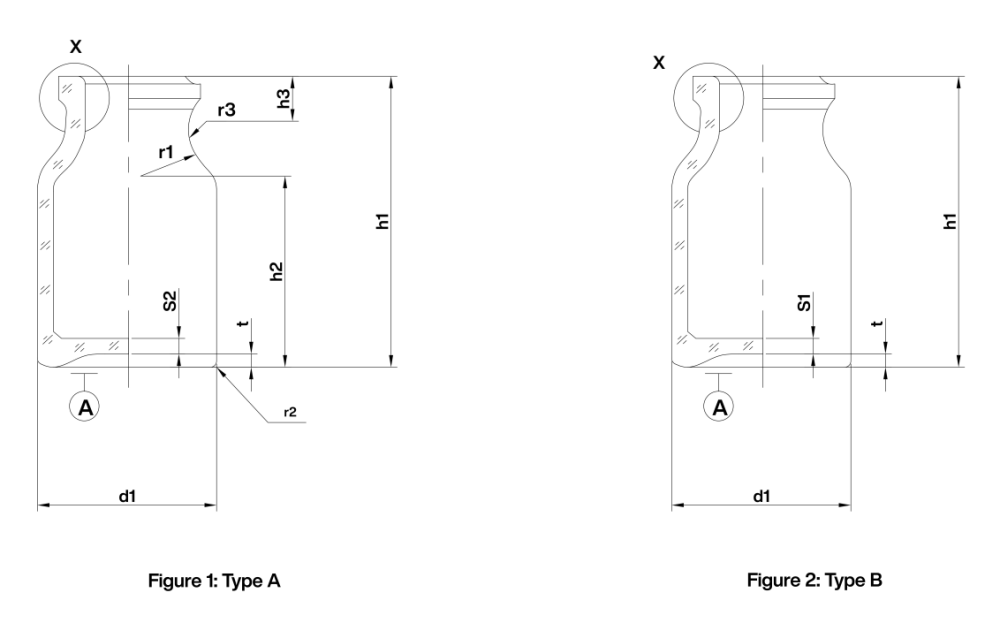
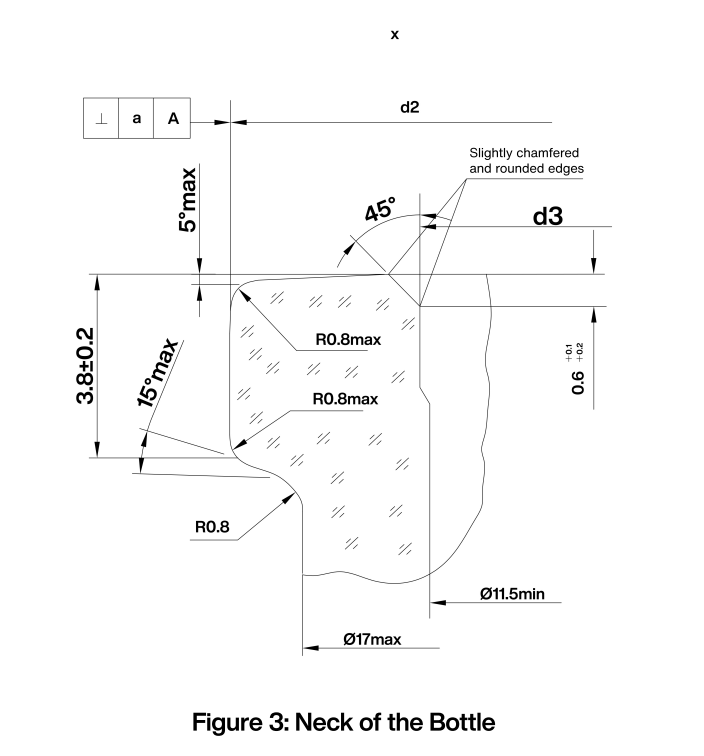
| Table 3 Main Specification Dimensions Unit:mm | ||||||||||||||||
| Specification(ml) | Vertical Axis Deviation amax |
Overall Bottle Height h1 |
Bottle Body Outer Diameter d1 |
Bottle Neck Outer Diameter d2 |
Bottle Neck Inner Diameter d3 |
Neck Wall Thickness S1 |
Bottom Thickness S2 |
Neck Outer Diameter d4 |
Neck Inner Diameter d5 |
|||||||
|
Dimension |
Tolerance |
Dimension |
Tolerance |
Dimension |
Tolerance |
Dimension |
Tolerance |
Dimension |
Tolerance |
Dimension |
Tolerance |
max |
min |
|||
|
5.0 |
Type A |
1.1 |
41.3 |
土0.5 |
20.8 |
土0.4 |
20.0 |
+0.2 |
12.6 |
土0.2 |
3.8 |
土0.3 |
3.0 |
土1.2 |
17.0 |
11.5 |
|
Type B |
38.7 |
22.0 |
||||||||||||||
|
7.0 |
Type A |
40.8 |
22.1 |
|||||||||||||
|
Type B |
38.7 |
24.5 |
||||||||||||||
|
8.0 |
Type A |
1.2 |
46.8 |
土0.6 |
23.0 |
|||||||||||
|
10.0 |
1.4 |
53.5 |
25.4 |
|||||||||||||
|
12.0 |
Type B |
1.5 |
56.8 |
27.0 |
-0.3 |
|||||||||||
|
15.0 |
Type A |
58.8 |
26.5 |
土0.5 |
||||||||||||
|
20.0 |
58.0 |
32.0 |
||||||||||||||
|
25.0 |
36.0 |
|||||||||||||||
|
30.0 |
1.6 |
62.8 |
土0.7 |
36.0 |
||||||||||||
|
50.0 |
1.9 |
73.0 |
土0.8 |
42.5 |
土0.8 |
|||||||||||
|
100.0 |
2.4 |
94.5 |
土0.9 |
51.6 |
||||||||||||
|
Table 4 Additional Specification Dimensions unit:mm |
|||||||||
|
Specification(ml) |
Full Capacity (ml) |
Weight (g) |
Concave Bottom Thickness (t) |
h2 |
h3 |
r1 |
r2 |
r3 |
|
|
≈ |
≈ |
≈ |
min |
min |
≈ |
≈ |
≈ | ||
|
5.0 |
Type A |
7.0 |
14.0 |
1.0 |
26.2 |
5.5 |
8.4 |
1.5 |
10.0 |
|
Type B |
7.3 |
14.5 |
|
|
|
|
|
||
|
7.0 |
Type A |
9.0 |
13.0 |
26.7 |
6.0 |
5.0 |
2.0 |
4.4 |
|
|
Type B |
14.5 |
|
|
|
|
|
|||
|
8.0 |
Type A |
10.0 |
16.0 |
29.5 |
6.0 |
9.5 |
1.5 |
7.0 |
|
|
10.0 |
15.0 |
21.0 |
35.3 |
5.7 |
10.0 |
2.0 |
5.1 |
||
|
12.0 |
Type B |
16.0 |
25.0 |
|
|
|
|
|
|
|
15.0 |
Type A |
17.0 |
24.0 |
36.5 |
5.8 |
15.0 |
2.5 |
9.5 |
|
|
20.0 |
26.0 |
29.0 |
36.1 |
5.5 |
12.0 |
3.0 |
6.1 |
||
|
25.0 |
32.0 |
30.0 |
1.5 |
34.0 |
6.5 |
5.0 |
|||
|
30.0 |
38.0 |
35.0 |
40.8 |
5.5 |
4.3 |
||||
|
50.0 |
60.0 |
50.0 |
46.0 |
6.0 |
12.5 |
8.5 |
|||
|
100.0 |
119.0 |
89.0 |
2.0 |
58.0 |
5.8 |
25.6 |
4.0 |
7.0 |
|