
Lightweight Doesn’t Mean “Less Strength”
The Hidden Factors Behind Glass Bottle Safety in High-Speed Filling
As the global packaging industry continues to pursue lightweight solutions, glass bottles are becoming increasingly lighter. At the same time, filling speeds are accelerating, logistics are becoming more complex, and consumers are paying unprecedented attention to product safety and quality.
Under these combined pressures, lightweighting is no longer just a matter of “reducing weight”; it is a comprehensive test of the overall quality management system of glass bottles.
In practice, many manufacturers encounter a similar dilemma when pursuing lightweight bottles: even when bottles are designed thinner and meet dimensional standards, breakage or bottle explosion issues may arise during high-speed filling or real-world usage. The root cause is often not structural design but insufficient control of the glass’s intrinsic quality.
The Real Challenge Lies in the “Invisible” Details
Traditionally, glass bottle strength relied heavily on wall thickness and overall weight. However, under lightweight conditions, the safety and performance of glass bottles increasingly depend on the homogeneity of the glass itself.
In other words, as the “outer” wall becomes thinner, the “inner” consistency must be more stable.
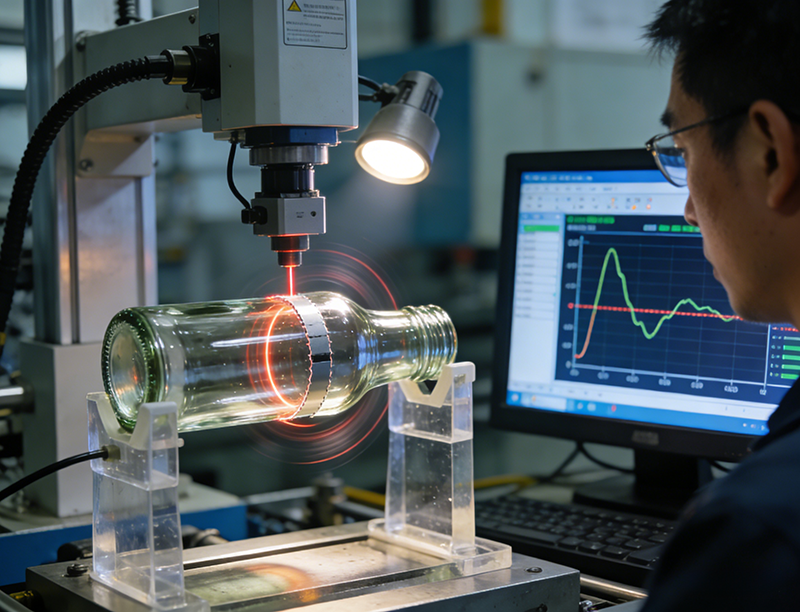
One often overlooked but critical metric in this context is cross-sectional homogeneity, or cut-surface uniformity. This measurement reflects how evenly components are distributed within the glass and indicates the presence and severity of internal defects, such as streaks or inclusions.
Ideally, homogeneous glass exhibits isotropic physical and chemical properties—meaning the glass behaves consistently under stress from any direction. Once internal component distribution is uneven, hidden defects form. These defects are usually not visible in standard inspections but can initiate cracks under high-speed filling, thermal shocks, or mechanical stresses.
Why Lightweight Glass Bottles Are More Sensitive to Homogeneity
In traditional, heavier glass bottles, thicker walls can partially compensate for insufficient internal homogeneity. As bottles become thinner, this “safety margin” quickly disappears.
On high-speed filling lines, glass bottles experience higher-frequency impacts and greater instantaneous stress. Under alternating temperature conditions, any non-uniformity in the glass composition can create localized stress points, increasing the risk of breakage.
This explains why, under lightweight conditions, two bottles of similar weight from different batches or manufacturers can perform very differently in real-world applications.
From an application perspective, low cross-sectional homogeneity means unstable strength. Glass that fails to reach ideal uniformity is more prone to breaking under thermal or mechanical stress, sometimes even randomly, creating a risk of unexpected bottle failures that directly affect filling efficiency, brand reputation, and end-user experience.
The Real Competition in Lightweighting Is Manufacturing Capability
A mature approach to lightweight glass bottles is not simply “making the walls thinner.” It requires full control over the manufacturing process. Homogeneity management is central to every critical stage of production.
- Raw Materials: Stability in composition and particle size is crucial. Frequent formula changes or poor particle size control can lead to uneven glass melt in the furnace, forming streaks.
- Batch Preparation: Accurate and thorough mixing ensures even distribution of glass components. If batches are uneven or segregate before entering the furnace, even ideal melting conditions cannot eliminate internal compositional differences.
- High-Temperature Melt Management: Furnace design, stable melting temperatures, controlled glass levels, and well-managed bubbling systems all contribute to uniformity. Additionally, volatile materials, dust, or refractory erosion can unintentionally disrupt glass composition and reduce bottle strength.
From “Meeting Standards” to “Fit-for-Purpose Performance”
With increasing filling speeds and usage requirements, evaluating glass bottles is moving from “does it meet standards?” to “does it truly perform under actual conditions?” For lightweight bottles, cross-sectional homogeneity is no longer just a lab metric; it directly affects filling stability, breakage rates, and the user experience.
Manufacturers must adopt proactive monitoring and process control. Once cross-sectional homogeneity deviates from target levels, root causes should be systematically investigated across raw materials, batch preparation, and melting conditions, followed by timely adjustments. Continuous, stable homogeneity management ensures that lightweight bottles maintain consistent strength and safety.
The Goal of Lightweighting: Reliable Packaging Solutions
In today’s competitive packaging industry, lightweighting is a trend, but the real differentiator is who can deliver consistency and reliability.
For glass bottle manufacturers, the hidden homogeneity inside the glass often determines product safety and performance. Bottles that maintain stable strength while being lightweight reflect not only advanced production technology but also a long-term commitment to quality and attention to detail.
Ultimately, the competition in lightweighting is not about making bottles thinner—it’s about making them reliably safe and dependable, even under the most demanding high-speed filling and real-world conditions.