
Key Technologies and Process Insights in Press-and-Blow Glass Bottle Production
From Gob to Parison: Precise Control of the Pressing Process for Lightweighting, High Output, and Premium Finish Quality
Over nearly a century of glass bottle and jar manufacturing, countless pioneers and technical experts have contributed their experience, experimentation, and innovation, laying a solid foundation for modern bottle-making technology. Their efforts have enabled later generations of manufacturers to avoid detours and achieve faster technical advancement. Today, from an industry perspective, we share several core processes and critical considerations of the Press-and-Blow (P&B) method in glass bottle production, helping manufacturers better understand key technical points, optimize production efficiency, and enhance product quality and customer satisfaction.
The press-and-blow method is a forming process in which a plunger directly presses molten glass to form the initial parison. Compared with other bottle-making processes, press-and-blow offers several advantages: stable finish dimensions, no air ring at the finish, more uniform glass distribution, the ability to achieve lightweight bottles, and higher production output. However, this process also has limitations—complex bottle designs are not well suited, and products with large or thick finishes are more prone to deformation or cracking during pressing. Therefore, a thorough understanding of the process characteristics and key control parameters of press-and-blow is essential to ensuring product stability.
In press-and-blow production, precise control of gob weight is critical. If the gob is too light, the finish may be insufficiently formed; if too heavy, double finishes may occur. By maintaining a stable glass level, adopting advanced forehearth combustion control systems, precisely controlling plunger timing and position, and implementing standardized operating procedures, manufacturers can effectively stabilize gob weight and significantly reduce defect rates.
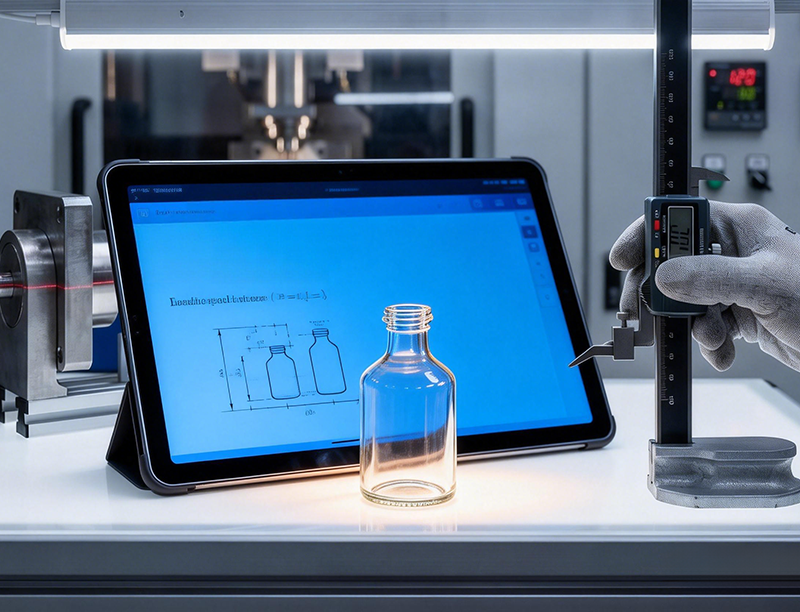
The plunger in the press-and-blow process has three key positions: the invert position, the loading position, and the pressing position. The invert and loading positions are determined by the plunger sleeve length, while the pressing position is defined by mold design. The selection of the sleeve length should ensure that, at the loading position, the tip of the plunger extends approximately 10–15 mm above the blank mold top surface (except for short bottles). This design ensures that the gob enters the blank mold accurately and consistently, forming a stable parison.
An important concept is the loading height, which refers to the distance between the top of the gob and the seating area where the blank mold mates with the baffle after the gob enters the blank mold. If the loading height is too low, excessive glass accumulates at the lower part of the blank mold, leading to defects such as thick shoulders or finish fins. If the loading height is too high, the gob may not fully enter the blank mold, and the baffle may press against the glass, causing glass flakes to adhere to the bottle base. In such cases, higher pressing force is required, increasing the risk of finish cracking or seam opening. Therefore, optimizing the loading height is a key parameter that must be determined through careful adjustment and production experience.
It is important to note that the loading position should not be determined by the plunger down OFF timing. Only when the plunger is completely stationary at the loading position and the gob enters the blank mold can consistent loading depth be ensured, preventing defects such as double finishes or bottom blowouts. Typically, the coordination between plunger down OFF and blank mold close ON should be kept consistent (with special cases adjustable via the core cylinder), ensuring each bottle receives sufficient and uniform forming pressure.
While ensuring that the finish is fully pressed, pressing force should be minimized as much as possible. In practice, this can be achieved by setting a slightly higher gob temperature and initiating pressing earlier, allowing the glass to be formed in a softer state and reducing reliance on high pressing force. At the same time, maintaining machine precision and optimizing the design of the blank mold, plunger, and finish mold allow the parison to form smoothly even under lower pressing forces. For example, incorporating a funnel-shaped design in the blank mold finish area helps reduce pressing force while ensuring proper forming quality.
During pressing, the pressure applied to the glass is inversely proportional to the square of the finish inner diameter. This means that, under the same pressing force, a smaller finish diameter results in higher stress on the glass, increasing the likelihood of finish cracking or seam defects. Accordingly, small-finish bottles require lower pressing force, while large-finish bottles require higher pressing force to balance glass stress and reduce defect risks. Some production practices offer the following empirical formulas as reference:
Large-finish press-and-blow: P = 0.04 × d²
Medium-finish press-and-blow: P = 0.08 × d²
Small-finish press-and-blow: P = 0.12 × d²
Where P is the pressing force (kg/cm²) and d is the finish inner diameter (cm). These formulas are empirical references only and generally apply to finishes with inner diameters not exceeding 65 mm.
In addition, the solidification state of the parison has a significant impact on final bottle quality. It is mainly influenced by plunger temperature, pressing time, pressing force, and blank mold temperature. If the parison is too cold, defects such as insufficient shoulder formation, cracks, finish fractures, and seam issues may occur. If the parison is too hot and cooling is uneven, deformation or cracking can result. The design of the plunger cooling core is therefore critical, including the location, diameter, and number of cooling channels. For double-gob press-and-blow products, pressing time is typically around 1.4 seconds—shorter for thin-walled bottles and longer for thick-walled bottles—and should be adjusted according to product specifications.
Finally, effective cooling of the bottle finish is essential to preventing finish deformation and uneven sealing surfaces. The selection of long air nozzles, finish mold materials, and heat dissipation design must all be scientifically and reasonably engineered to ensure the finish maintains a stable shape during pressing and cooling, thereby improving product consistency and reliability.
In summary, the press-and-blow method offers significant advantages in glass bottle production: stable finish dimensions, uniform glass distribution, lightweighting potential, and high output. However, to fully realize these benefits, manufacturers must deeply understand and control every key aspect of the pressing process—gob weight, loading height, plunger movement, pressing force, parison temperature, and finish cooling. Through standardized operations, precise control, and optimized mold design, finish defect rates can be significantly reduced and overall product consistency greatly improved. For customers in high-end beverage, pharmaceutical, and cosmetic industries, this not only ensures product quality and safety but also reflects the manufacturer’s technical strength and professional image—key factors for standing out in a competitive market.