
Bottom Offset and Puckered Shoulder Lines: Insights into Consistent Glass Bottle Formation
Mastering parison temperature, alignment, equipment, and mold design to achieve uniform bottle bottoms and stable bottle bodies
In glass bottle manufacturing, bottom offset and puckered shoulder line defects are among the most critical issues affecting product quality. These defects are particularly prevalent in square or flat bottles and can compromise both appearance and structural integrity. Bottom offset or shoulder line deviation can result in excessively thin areas, insufficient strength, and increased risk of breakage during filling, transport, or stacking. While the technical solutions for these defects are not complex, the real challenge lies in ensuring consistent, stable quality across all products and preventing defects at the source.
The primary causes of these defects can be categorized into four groups: uneven parison temperature, parison not vertically suspended, misaligned equipment, and improper mold design. Corresponding countermeasures involve comprehensive optimization across process, equipment, molds, and management.
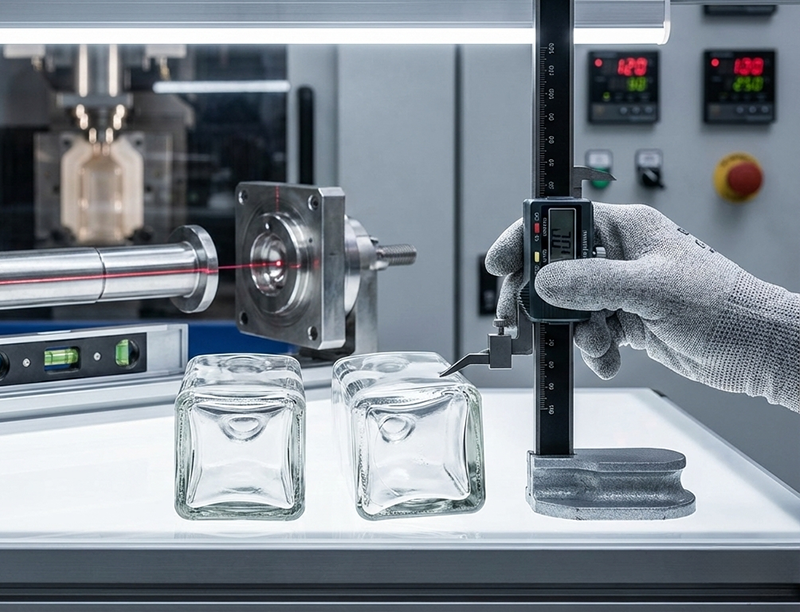
First, uneven parison temperature is one of the most common causes of bottom offset and shoulder line deviation. In press-and-blow production, if the parison bottom temperature is uneven, areas with higher temperature will over-extend and become too thin during final blow, while cooler areas may under-expand, resulting in uneven thickness at the bottle bottom. Several factors contribute to uneven parison temperature, including variations in drop temperature, unequal mold side temperatures, excessive cooling from side air, poor drop placement, over-counter-blow, over-stamping, or early final blow with insufficient reheating time. To ensure uniformity, the thermal efficiency of the glass feed system must reach at least 92%. Temperature control is not only a process adjustment but also a key determinant of product stability and defect reduction.
Second, parisons not vertically suspended in the mold can also cause uneven bottle bottoms and thickness variations. If the parison is tilted, the bottom glass cannot expand evenly during the final blow, naturally producing thick or thin areas. Factors such as too fast or too slow parison rotation, overly soft glass, poor exchange between the neck mold and the final mold, and insufficient mold venting can all cause the parison to bend or tilt. These issues are most critical during product changeovers, requiring precise adjustment, while daily operations must maintain process parameters within standard ranges. The use of positioning points in both the initial and final molds can help ensure vertical suspension, reducing bottom offset and shoulder line deviations.
Third, misaligned equipment components can lead to uneven glass distribution. Press-and-blow equipment with off-center plungers, blow heads, or blow pipes can produce uneven expansion in the parison, resulting in bottom offset or puckered shoulder lines. While technically straightforward to correct through full inspection and precise calibration, the key lies in meticulous, careful operation. Consistent attention to alignment ensures uniform glass distribution and stable bottle formation.
Fourth, improper mold design contributes to uneven bottle bottoms and shoulder lines. If the extension ratio is too large or the ratio between the initial mold diameter and bottle bottom diameter is unsuitable, glass distribution at the bottom becomes unstable during the final blow. Square or flat bottles are particularly sensitive to this. Excessive extension can result in noticeable thick-thin variations; a too-large initial mold to bottle bottom diameter ratio may cause the shoulder line to fold up onto the bottle body, while a ratio that is too small can produce a “moon bottom.” Optimizing mold design includes adopting a parison-contoured mold, controlling the extension to roughly 10% of the parison length, and adjusting the initial mold to bottom diameter ratio between 0.75–0.80, depending on bottle weight and type. Proper adjustment ensures a stable, uniform bottom with minimal thickness variation.
Systematically addressing these four factors can significantly reduce bottom offset and shoulder line deviation while improving product consistency and stability. The core principle is source control: maintaining uniform glass temperature, ensuring vertical parison suspension, precise equipment alignment, and well-designed molds. Combined with standardized operating procedures, real-time monitoring of key parameters, regular equipment calibration, and careful adjustments during product changeovers, manufacturers can achieve consistent, defect-free production.